He said I used money to trap him.
Sienna believed him because the story made her feel chosen rather than cruel.
Then, three months before the club incident, Graham made a new promise.
He would announce our separation after the Ashford Foundation Winter Gala.
Sienna would become chief brand officer.
They would marry the following summer.
“He told me the club was his,” she said.
“Most things become his in the retelling.”
“He wanted the scene to happen.”
I held still.
“What?”
“He knew you had an appointment there. He said it was time people saw that you no longer controlled him.”
The humiliation had not been impulsive.
It had been staged.
Graham wanted the world to watch him replace me.
Not merely ego.
Public narratives affect negotiations. A discarded wife appears emotional. Unstable. Vindictive. If I challenged business transfers after a public marital collapse, Graham could frame the dispute as revenge.
He had wanted me to scream.
To strike Sienna.
To become a viral image of feminine humiliation.
Instead, the scanner spoke.
Sienna opened her bag and removed a small black device.
“I recorded him,” she said.
“After I saw the blonde woman.”
“What did he say?”
“He said you would be gone by the gala.”
I looked at Sebastian through the glass wall.
His expression sharpened.
“Gone how?” I asked.
Sienna swallowed.
“He said, ‘Vivienne will not be a problem after December.’”
The Winter Gala was nine days away.
“Did he explain?”
“Why didn’t you go to the police?”
“Because I didn’t know whether he meant divorced, discredited, or…”
“Dead?”
Her silence answered.
I took the recorder.
It contained four hours of conversations.
In one, Graham discussed moving assets after “the final Mercer event.”
In another, he told someone called C that the trust would become accessible if I were found mentally incompetent.
Then came the recording that changed everything.
Graham’s voice, calm and intimate:
“She will sign at the gala. If she refuses, the medication will make the situation persuasive.”
Sienna whispered, “What medication?”
“Something that creates confusion. Nothing permanent.”
“And if she goes to a hospital?”
“Then we have documented instability. Either way, she loses control.”
My body went cold.
The plan was not to kill me.
It was more elegant.
Drug me at the gala.
Cause a public episode.
Produce witnesses.
Use the episode to challenge my competence and trigger emergency control provisions in the trust.
Graham had not merely planned to leave me.
He had planned to erase my legal identity while I was still alive.
Sebastian entered the room.
“We’re contacting federal authorities,” he said.
“No,” I replied.
His expression hardened.
“We contact them after the gala.”
“That is not negotiable.”
“It is my life.”
“Exactly.”
“And if we move now, Graham claims Sienna fabricated the recordings after their affair collapsed. He buries the accounts, destroys the files, and turns himself into the victim of two angry women.”
“You are not walking into a room where he intends to drug you.”
“I won’t drink anything he controls.”
“That is not enough.”
“Then protect the room.”
Sienna looked between us.
“What are you planning?” she asked.
I thought of Graham in the club lobby.
His hand on the counter.
His smile when he believed he was stripping away my access.
Powerful men often mistake public cruelty for a final move.
They do not understand that humiliation can become evidence.
“The gala proceeds exactly as he expects,” I said.
Sebastian’s eyes narrowed.
“And what does he expect?”
“That I will arrive as his wife.”
CHAPTER THREE
A GALA FOR THE BEAUTIFULLY DOOMED
The Ashford Foundation Winter Gala was held every December in the Grand Aurelia Ballroom.
Three thousand white roses covered the walls.
A mirrored runway crossed a black reflecting pool.
A string orchestra played from a platform suspended above the guests.
Tickets began at twenty-five thousand dollars.
People called it charity because the checks funded arts programs, hospital wings, and scholarships.
People attended because the room decided who mattered.
That year, six hundred guests arrived expecting to witness the final performance of America’s most elegant marriage.
Rumors had spread.
The cryotherapy video remained everywhere.
Graham’s public relations team described it as a “misunderstood private transition.”
My team said nothing.
Silence kept the story alive.
Nine days gave us enough time to prepare.
Not enough time to recover.
Sienna agreed to cooperate in exchange for consideration from prosecutors and protection against Graham.
She returned to his apartment.
She apologized.
She cried.
She told him jealousy had frightened her.
Graham forgave her because arrogance makes suspicion difficult to sustain. He believed Sienna loved him more than she feared prison.
For seven days, she wore a wire.
We learned the plan.
At the gala, Graham would present me with an amended trust authorization disguised as a routine foundation document.
If I refused to sign, a sedative would be placed in my champagne.
A physician loyal to Graham would declare me disoriented.
Two board members would sign emergency affidavits.
By morning, Graham intended to petition for temporary control of the Mercer Crown Trust.
He had prepared headlines describing my breakdown.
The files were already saved on his publicist’s server.
TRAGEDY BEHIND THE PERFECT MARRIAGE.
SOURCES SAY VIVIENNE ASHFORD HAS STRUGGLED FOR YEARS.
GRAHAM ASHFORD ASKS FOR PRIVACY AS WIFE ENTERS TREATMENT.
The cruelty was not merely personal.
It was professional.
He intended to turn my collapse into brand management.
We also learned the identity of C.
Charles Mercer.
My uncle.
The man who had hugged me at my father’s funeral and promised I would never be alone.
Charles had helped Harrison Ashford divert money from Mercer Capital decades earlier.
Richard Marrow discovered it.
According to the evidence Sebastian obtained from an encrypted archive, Charles arranged the sabotage that killed Richard.
Years later, when Elena Cross came close to proving it, Charles caused the accident that killed her too.
My father began investigating.
Before he could expose his brother, he suffered his fatal heart attack.
Toxicology samples no longer existed.
But one of Charles’s old assistants had preserved appointment books and payment records.
The night before my father died, Charles paid a private nurse who later moved to the Cayman Islands.
We did not yet have proof of murder.
We had a pattern.
Fraud.
Bribery.
Obstruction.
And Graham’s current conspiracy to steal the trust.
The older crimes would require time.
The gala would give us the present one.
Sebastian opposed the plan until the final hour.
“You do not need to stand in front of six hundred people to prove you are brave,” he told me.
We were in the penthouse dressing room.
My gown hung nearby: black velvet, long-sleeved, cut with severe simplicity. No glitter. No softness. A dress designed not to seduce but to declare.
“This is not about bravery.”
“Then what is it about?”
“Control.”
“Control is leaving before he can touch you.”
“No. That is survival.”
“Survival is enough.”
“It was enough for my mother. Enough for your mother. Enough for every woman who vanished quietly so powerful men could remain comfortable.”
He moved closer.
“You are not responsible for avenging every woman who was betrayed.”
“Then stop speaking as though you owe the world a spectacle.”
“I owe myself an ending.”
Anger left it.
What remained was fear.
Not the possessive fear Graham performed whenever he thought something belonged to him.
Sebastian’s fear had no demand inside it.
He did not want obedience.
He wanted me alive.
“I cannot lose you to this family,” he said.
The words were almost a whisper.
“You won’t.”
“You cannot promise that.”
“No,” I said. “But I can promise that I will not disappear politely.”
He closed his eyes for a moment.
When he opened them, the attorney had returned.
“The ballroom security team has been replaced. Federal agents will be positioned among the staff. Your glass will never leave visual contact. The document table has been fitted with forensic cameras. The physician Graham hired is cooperating.”
“We showed him the federal indictment prepared for conspiracy.”
“Persuasive.”
“He found his conscience.”
“Men often locate morality near prison doors.”
Sebastian almost smiled.
Then he reached into his pocket.
“I have something for you.”
He placed a small velvet box on the dressing table.
Inside was a slim platinum bracelet.
No diamonds.
No decoration.
“It contains a biometric distress signal,” he said. “Press the inner clasp twice.”
“You bought me tactical jewelry.”
“I know your preferences.”
“You don’t know all of them.”
His gaze met mine in the mirror.
For one suspended second, the room became painfully intimate.
I imagined turning.
I imagined his hand at my waist.
I imagined discovering whether the restraint between us would shatter or deepen if touched.
Then the moment passed.
He fastened the bracelet around my wrist.
His fingers brushed my pulse.
Neither of us moved.
“Come back from the gala,” he said.
It was not a command.
It was the closest thing to a plea I had ever heard from him.
“I will.”
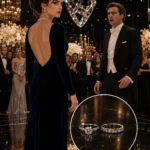
The Grand Aurelia Ballroom fell silent when I entered.
Graham waited at the end of the mirrored runway wearing a white dinner jacket.
He looked magnificent.
That was always part of the danger.
Cruel men rarely present themselves as monsters. They arrive beautifully tailored and hold doors open while deciding which parts of your life to steal.
Sienna stood near him in silver.
She avoided my eyes.
The performance had begun.
Cameras turned.
Guests whispered.
I walked forward alone.
At the center of the room, Graham extended his hand.
I gave him mine.
Applause rose around us.
“Smile,” he murmured.
“I am.”
“You look like you’re attending a funeral.”
“Perhaps I am.”
His grip tightened.
Then he kissed my cheek for the cameras.
“Behave tonight,” he whispered. “And I may still protect you.”
I looked into his eyes.
“From whom?”
“Yourself.”
The orchestra began.
We opened the gala with a dance.
Graham’s hand rested against my back. Mine lay on his shoulder.
Around us, six hundred guests watched the illusion move gracefully beneath chandeliers.
“You’ve been busy,” he said.
“So have you.”
“I’m told you froze several accounts.”
“Temporary review.”
“You embarrassed Sienna.”
“She survived.”
“You enjoy this version of yourself.”
“What version?”
“The cold one.”
I smiled.
“You confuse warmth with obedience.”
He turned me across the floor.
“You will sign the foundation resolution tonight.”
“Will I?”
“It protects the family if you become unable to manage your responsibilities.”
“How thoughtful.”
“You’ve been under pressure.”
“From discovering my husband’s affair or his fraud?”
His fingers pressed harder.
“Careful.”
“Is that concern?”
“It is advice.”
The song ended.
We faced the room.
Applause.
Graham smiled.
From the edge of the ballroom, Sebastian watched us.
He wore black.
He did not look jealous.
He looked ready.
Dinner began.
At my place setting rested a crystal glass of champagne.
I did not touch it.
Graham raised a toast to renewal.
Sienna sat two tables away beside a famous actor and a senator’s wife. Her hands shook once beneath the table.
Charles Mercer arrived late.
He walked with a silver-headed cane and wore my father’s cuff links.
I felt something inside me become still.
He kissed my forehead.
“My beautiful girl,” he said.
“Uncle Charles.”
“This unpleasantness with Graham will pass.”
“Will it?”
“Marriage requires forgiveness.”
“So does family.”
His eyes searched mine.
For a second, I wondered whether he knew.
“You look like your mother tonight.”
“I hope that frightens you.”
His smile did not disappear, but it became careful.
The program began.
A film showed children receiving music scholarships.
A surgeon spoke about a new pediatric wing.
A Broadway singer performed.
Then Graham took the stage.
He thanked donors.
He praised the board.
He spoke about legacy, responsibility, and the importance of protecting institutions from personal instability.
The word was deliberate.
Cameras turned toward me.
Graham extended his hand.
“Vivienne, would you join me?”
I rose.
The ballroom glittered.
Every face seemed sharpened by curiosity.
I climbed the steps.
Graham kissed my cheek again.
On a table behind him lay a leather folder.
The document.
“My wife,” he told the guests, “has given this foundation its heart.”
“Tonight, we are strengthening the structure that will protect her work for generations.”
He opened the folder.
“Our board has approved a routine continuity resolution. Vivienne and I will sign together.”
A pen waited.
He signed first.
Then he offered it to me.
The room held its breath.
I looked at the page.
It granted Graham emergency authority over the Mercer Foundation, Mercer Crown Trust distributions, and every business in which I held controlling interest.
Routine.
Continuity.
Protection.
Three elegant words wrapped around a theft.
“I have one question,” I said.
Graham’s smile remained fixed.
“Why does a foundation resolution include control of my private trust?”
A murmur traveled through the room.
“This is not the place.”
“You chose the place.”
“Sign it.”
The refusal echoed through the ballroom.
Graham laughed softly for the audience.
“Vivienne has always read every line.”
“As should every woman asked to sign away her identity.”
The murmurs grew.
Graham’s eyes hardened.
He turned toward a server.
The champagne was coming.
A young man approached carrying a silver tray.
One glass contained a microscopic blue mark near the stem.
The sedative.
The server offered it to me.
I accepted.
Sebastian’s body tightened across the room.
Graham relaxed.
“Perhaps a toast,” he said.
“To what?”
“New beginnings.”
I raised the glass.
Then I handed it to Charles.
“My uncle should have the honor.”
Charles froze.
Graham’s face changed.
Only slightly.
But the federal cameras caught it.
Charles looked at the champagne.
“No, no,” he said. “The moment belongs to you.”
“I insist.”
He did not take the glass.
Guests shifted in their seats.
“Is something wrong with it?”
Graham reached for the glass.
I stepped back.
At once, two ballroom doors closed.
The security locks engaged.
The orchestra stopped.
Graham stared at me.
“What have you done?”
“Created continuity.”
Sebastian walked onto the stage.
Behind him came three federal agents.
The room erupted in whispers.
Graham looked toward the exits.
Sienna stood.
Her chair fell behind her.
Graham’s gaze snapped toward her.
“You.”
Sienna’s face had gone white.
“I’m sorry,” she whispered.
“No,” he said. “You’re stupid.”
The cruelty in his voice stripped away her remaining illusions.
I placed the champagne on the document table.
A forensic technician sealed it inside an evidence container.
One of the agents approached the microphone.
“Ladies and gentlemen, please remain seated. No guest is under investigation solely for attending this event.”
“Under investigation?” Graham said. “This is a private foundation gala.”
“Not anymore,” I replied.
Charles began moving toward the side stairs.
Two agents stopped him.
He looked at me with naked hatred.
“You ungrateful little fool.”
The words reached every speaker in the ballroom.
My father’s brother.
My childhood protector.
His mask was gone.
“Ungrateful for what?” I asked. “The funeral? The forged records? Or the nurse you paid the night my father died?”
The ballroom became silent.
Charles stared at me.
Then he laughed.
“You have no idea what your father was.”
“I know what you were.”
Graham stepped toward me.
“This is defamation.”
Sebastian handed him a document.
“No. This is a temporary restraining order freezing your personal and corporate accounts.”
Graham did not take it.
“You cannot freeze Ashford House.”
“Vesper Holdings can,” I said.
He turned toward me.
At last, true fear appeared.
“What does Vesper have to do with this?”
“Vesper owns your senior debt.”
“I know what it owns.”
“No,” I said. “You know what you borrowed.”
I let the pause widen.
“I own Vesper.”
The reaction moved through the room like a physical force.
“That’s impossible.”
“Mercer Crown acquired the debt during your liquidity crisis.”
“You said the trust was passive.”
“You said Sienna was a consultant.”
His face reddened.
“The debt is not in default.”
Sebastian opened another folder.
“It became callable when you pledged unauthorized trust assets, submitted a forged guarantee, and diverted loan proceeds to entities under undisclosed control.”
Graham looked toward two Ashford House board members.
They did not meet his eyes.
I continued.
“Twenty minutes ago, the board voted to remove you as chairman and chief executive.”
“You do not control the board.”
“I control the debt. The ground leases. The Manhattan property. The Charleston property. The Napa estate. And, as of four o’clock this afternoon, seventy-two percent of voting shares.”