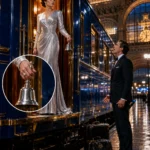
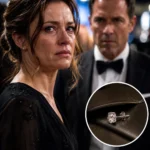
My husband gave his mistress my bidder paddle beneath a chandelier made from six thousand pieces of Venetian glass.
He did it casually.
Almost tenderly.
As though passing her the right to purchase my family’s history was no different from offering her the last sip of his champagne.
“Go ahead, Sloane,” Julian murmured. “Buy something beautiful.”
Sloane Avery curled her manicured fingers around the ivory paddle marked 18 and smiled across the candlelit ballroom at me.
Not a nervous smile.
Not the guilty smile of a woman caught sleeping with another woman’s husband.
It was the serene, polished smile of someone who believed the wife had already lost.
Around us, eighty of Manhattan’s wealthiest collectors sat beneath the painted ceiling of the Halcyon Club’s private dining room. Old banking families. Museum trustees. Hedge-fund founders. Two European princes who had inherited more titles than liquidity. Every woman wore diamonds bright enough to cut the darkness. Every man spoke in the low, confident tones of people accustomed to being obeyed.
At the center of the room, inside a climate-controlled glass case, rested a gold coin no larger than a silver dollar.
A 1907 Saint-Gaudens Ultra High Relief double eagle.
The Mercer Sunrise.
My grandfather’s coin.
The last time I had seen it, I was fourteen years old and standing in his library in Newport while summer rain ran down the windows.
He had placed the coin in my palm and closed my fingers around it.
“Gold is only metal, Vivian,” August Mercer had told me. “What matters is the hand that refuses to sell what cannot be replaced.”
Twenty-three years later, my husband’s mistress raised my paddle to buy it.
“One million eight hundred thousand,” the auctioneer announced.
A ripple moved through the room.
Sloane’s shoulders straightened.
Julian leaned back in his chair, looking pleased with himself.
He had seated her beside him at a dinner where I was the invited guest and she was officially listed as his “strategic adviser.” He had worn the cuff links I gave him on our tenth anniversary. She wore the emerald earrings that had disappeared from my jewelry safe three months earlier.
The humiliation had been designed with care.
Julian always believed cruelty became respectable when it was wrapped in etiquette.
The auctioneer glanced toward me.
“Mrs. Cross, would you care to respond?”
Every face turned in my direction.
Julian lifted his champagne glass.
“Vivian doesn’t collect anymore,” he said before I could answer. “She’s become sentimental.”
A few people laughed softly.
Sloane raised my paddle again.
“One million nine hundred thousand,” the auctioneer said.
I folded my hands in my lap.
My wedding ring caught the candlelight.
May you like
Sloane looked directly at it.
Then she looked at Julian.
“Family history should stay in the family,” she said sweetly.
Julian’s mouth curved.
“Family history belongs to whoever can afford it.”
The laughter was louder this time.
I let it happen.
I let them see the wife who had been placed three chairs away from her own husband.
I let them watch his mistress bid on the coin my grandfather had once carried in his pocket.
I let Julian believe my silence was surrender.
Then the auctioneer opened the black provenance folder.
“Before accepting the next bid,” he said, “the consignor has requested that the full chain of ownership be read into the record.”
Julian’s smile faded slightly.
Sloane lowered the paddle.
The auctioneer adjusted his glasses.
“The Mercer Sunrise was acquired by August W. Mercer in 1979. Upon his death, legal title transferred to the Aurelius Heritage Trust, whose sole controlling beneficiary is Mrs. Vivian Mercer Cross.”
The room went still.
I rose from my chair.
The silk of my black gown whispered across the floor.
Julian stared at me.
Sloane’s fingers tightened around my paddle.
I looked at the auctioneer.
“As controlling beneficiary,” I said, “I am withdrawing the coin from sale.”
The gavel never fell.
The room erupted in murmurs.
Julian pushed back his chair.
“You can’t do that.”
I turned toward him.
It was the first time I had looked directly at my husband all evening.
“Yes,” I said. “I can.”
Sloane laughed, but the sound came out thin.
“Then why put it up for auction?”
I allowed myself a small smile.
“Because I needed to know who would try to buy property they had already used as collateral.”
Julian stopped breathing.
That was the moment the evening truly began.
CHAPTER 1: THE WOMAN AT THE WRONG TABLE
Three weeks before the auction, I found a second wedding ring in my husband’s coat pocket.
It was not mine.
Mine was an antique platinum band set with a row of tiny diamonds, chosen by Julian because he said modern jewelry looked temporary.
The ring in his pocket was new, bright and almost indecently large.
A pear-shaped yellow diamond surrounded by white stones.
Inside the band, two initials had been engraved.
J + S.
I stood alone in the dressing room of our Fifth Avenue penthouse, holding it beneath the soft lights.
Outside the windows, Manhattan glittered below me.
For eleven years, Julian and I had lived forty-eight floors above the city. The apartment had limestone floors imported from France, a private elevator and a library lined with first editions no one but me ever opened.
People called it the Cross residence.
That had always amused my grandfather.
The deed belonged to the Aurelius Heritage Trust.
Julian had never known.
He had asked once why the title company sent documents to a law office instead of our home.
I told him it was how my family handled property.
He kissed my forehead and said, “Old money loves unnecessary paperwork.”
Julian believed my inheritance consisted of a modest portfolio, a Newport house in need of repairs and a handful of heirlooms.
He believed that because I allowed him to.
My grandfather had taught me that a fortune was safest when loud men mistook it for decoration.
I returned the yellow diamond ring to Julian’s pocket.
Then I called Naomi Graves.
Naomi had been counsel to the Mercer family for eighteen years. She was fifty-two, silver-haired and incapable of pretending stupidity was charming.
She answered on the second ring.
“What happened?”
Naomi never said hello when I called after midnight.
“I found a ring.”
A pause.
“Purchased for you?”
“No.”
“Do you know the woman?”
“I have a strong suspicion.”
Sloane Avery had entered Julian’s life nine months earlier as a consultant for Cross Continental, his luxury hospitality company.
At thirty-one, she had perfected the appearance of effortless privilege. She wore quiet European labels, spoke conversational French and posted photographs from hotels that usually required a six-month waiting list.
She was clever enough not to flirt with Julian in front of me.
She did something more dangerous.
She admired him.
Every word he said.
Every decision he made.
Every story he told about building Cross Continental from nothing.
The first time I met her, she had taken my hand and said, “You must be so proud of everything Julian created.”
I had smiled.
“I’m proud of many things.”
She had not understood the answer.
Naomi exhaled.
“Do you want me to hire an investigator?”
“Vivian.”
“I don’t need photographs of them leaving hotels. I need to know what he’s moving.”
That was the difference between heartbreak and strategy.
A photograph could prove adultery.
A ledger could prove theft.
My grandfather had never believed in dramatic confrontations. He said anger warned dishonest people that their time was running out.
“Smile,” he used to tell me. “Let them think the door is still unlocked.”
So I smiled.
For three weeks, I ate breakfast across from Julian while Naomi’s forensic accountants traced transfers between holding companies.
I attended a charity benefit with Sloane standing ten feet away in the emerald earrings from my safe.
I listened while Julian complained that I had become distant.
I apologized.
I even touched his hand.
The performance disgusted me, but disgust was useful. It kept me from confusing memories with reality.
The man across from me was not the twenty-nine-year-old entrepreneur who once waited outside my graduate seminar in the rain because he had forgotten his umbrella and wanted an excuse to walk me home.
He was not the man who had danced with me barefoot in my grandfather’s Newport kitchen.
He was not the husband who once whispered that he would rather fail beside me than succeed without me.
That man might never have existed.
Or perhaps success had not changed Julian.
Perhaps it had simply given him enough light to reveal himself.
Cross Continental had begun with one failing hotel in Boston.
Julian found the property.
I found the money.
He believed my contribution was a personal loan of three million dollars.
The truth was more complicated.
The Aurelius Heritage Trust had purchased the hotel’s debt, funded its renovation and licensed the Mercer name to Julian through a series of entities he never bothered to examine.
Over the next decade, Cross Continental expanded into Chicago, Miami, Los Angeles, Aspen and Charleston.
Magazine profiles called Julian a self-made visionary.
He liked that phrase.
Self-made.
As though my family’s capital had fallen from the sky.
As though the hotels’ most valuable real estate was not quietly owned by trusts under my control.
As though the preferred shares held by my grandfather’s foundation did not convert into voting control upon any finding of fraud, misuse of collateral or material breach of fiduciary duty.
I had never planned to use those provisions.
Love makes even intelligent women believe safeguards are insults.
My grandfather had insisted.
“Good contracts do not destroy marriages,” he said. “They reveal which marriages were already unsafe.”
On the fourth morning after I found the ring, Naomi called.
“We found something.”
I was sitting in the solarium, drinking coffee from my grandmother’s porcelain cup.
Julian was in Los Angeles.
According to his assistant, Sloane was in Toronto.
According to the flight manifests Naomi obtained, they had both landed in Saint-Tropez.
“What did you find?” I asked.
“A forty-million-dollar bridge loan issued to Cross Continental six months ago.”
“That isn’t in the board reports.”
“Lender?”
“Blackridge Capital.”
I knew the name.
Blackridge financed distressed companies at interest rates that bordered on predatory. Its contracts were designed to become ownership documents when borrowers missed payments.
“What was pledged?”
Naomi was silent for one beat too long.
“Several assets. Two hotel management contracts. Julian’s personal shares. And a group of Mercer collectibles listed as marital property.”
My hand tightened around the porcelain handle.
“What collectibles?”
“A collection of rare coins.”
The room seemed to narrow around me.
My grandfather had assembled one of the finest private collections of American gold coins in the country. After his death, the public believed most of it had been sold.
It had not.
The collection belonged to the Aurelius Heritage Trust and remained in insured vaults in New York, Zurich and Delaware.
Julian knew about a few pieces displayed at the Newport house.
He had no legal interest in any of them.
“Did he identify specific coins?”
“Yes.”
Naomi’s voice softened.
“One is the Mercer Sunrise.”
I set down the cup.
The sound against the saucer was small and precise.
“Where did he get the appraisal?”
“A man named Malcolm Vane.”
I knew that name too.
Vane had been dismissed from Bellweather & Cole Auction House eight years earlier after falsifying provenance documents. My grandfather had testified against him in a civil proceeding.
“Julian pledged a coin he doesn’t own,” I said.
“With a forged spousal consent.”
There it was.
Not adultery.
Not humiliation.
Not a missing pair of earrings.
Fraud.
“Show me the signature.”
Naomi sent the file.
The document appeared on my tablet.
My name curved across the final page in a near-perfect imitation.
Vivian Mercer Cross.
A stranger might have believed it.
Julian should have known better.
I never wrote the C in Cross with a closed loop.
My grandfather taught me to leave it open.
“An honest signature needs somewhere for the truth to escape,” he used to joke.
The forged C was closed.
A small mistake.
A fatal one.
“What happens if the loan defaults?” I asked.
“Blackridge can seize the pledged collateral and exercise an option over Julian’s shares.”
“When is the payment due?”
“Two weeks after the Halcyon auction.”
I looked toward the city.
“Why would the Mercer Sunrise be at the Halcyon auction?”
“It isn’t.”
“Not yet.”
Naomi understood me immediately.
“Vivian, you cannot use a federally insured collectible as bait without careful documentation.”
“That is why I have you.”
She swore softly.
It was one of the things I loved about her.
“Tell me what you’re thinking.”
“Julian pledged a coin he never possessed. Blackridge will eventually demand proof of control. If the coin appears at auction, he will need to acquire it before the loan review.”
“He might send an agent.”
“Then we identify the agent.”
“He might withdraw the collateral.”
“Then we ask why.”
“And if he bids personally?”
“We let him.”
Naomi was quiet.
“Until when?”
“Until the provenance is read.”
That afternoon, the Aurelius Heritage Trust consigned the Mercer Sunrise to Bellweather & Cole for a private auction at the Halcyon Club.
The consignment agreement contained a withdrawal clause exercisable solely by me.
The auction house’s compliance department notified all registered bidders that beneficial ownership information would be required for purchases above one million dollars.
Then we waited.
Julian came home from Saint-Tropez with a tan and a box of chocolates from an airport shop.
He kissed my cheek.
“Toronto was miserable,” he said.
“I’m sorry.”
“Sloane saved the presentation.”
“I’m sure she did.”
He studied me.
For a moment, I wondered whether he could see the difference.
The quiet was no longer passivity.