“What evidence do we have that Julian knew he lacked authority?” I asked.
“Not enough.”
“What evidence do we need?”
“Emails. Draft agreements. Internal communications. Proof of forged approvals. Proof he diverted company funds to create the appearance of authority.”
“And if we find it?”
“Civil fraud. Breach of fiduciary duty. Potential criminal exposure.”
I turned from the window.
“What about Celeste?”
Adrian did not answer immediately.
“She has received three point eight million dollars through consulting companies associated with the restoration.”
“For what services?”
“Most cannot be verified.”
“So she wasn’t merely sleeping with my husband.”
“She was helping him steal from me.”
The word landed more cleanly than the affair.
Bodies were one form of betrayal.
Books were another.
I thought of Celeste touching Julian’s hand in front of twenty-two people.
I thought of my grandmother’s missing emeralds.
I thought of all the years I had apologized for being too cautious while Julian moved money through rooms I had been told not to enter.
“What do you need from me?” Adrian asked.
I returned to the table and placed one hand on the acquisition agreement.
“Nothing,” I said.
His brow lifted.
“I need something from you.”
“What?”
“Do not save me.”
A shadow moved through his eyes.
“I mean it. You can advise me. You can tell me where the bodies are buried. But when this ends, no one will say Adrian Cross rescued the broken wife of Julian Harrington.”
He came closer.
“Then what will they say?”
I looked down at my husband’s signature.
Dark blue ink.
Confident strokes.
A man signing away a future he believed belonged to him.
“They’ll say I let him finish.”
# **CHAPTER TWO — THE LEDGER BENEATH THE VELVET**
The following morning, I moved out of the penthouse.
Julian had already given the building staff instructions to restrict my access to certain rooms.
He had also frozen the primary household account.
The cruelty was petty enough to be intentional.
He wanted me to understand that although my name appeared on the property records, the life inside the walls had belonged to him.
I packed one suitcase.
Three black dresses.
Two suits.
My mother’s pearls.
My father’s watch.
I left the wedding photographs in their silver frames.
Before I departed, I walked through every room.
The library where Julian had proposed beneath a painting he later sold without telling me.
The terrace where we had once eaten Chinese food from paper cartons during a summer blackout.
The bedroom where he had held me after my third miscarriage and promised that I was enough.
Not every tender moment had been false.
That made the betrayal more painful, not less.
People liked to imagine villains as creatures who had never loved anyone.
It was easier that way.
The truth was uglier.
Julian had loved me.
He had simply loved what my life could make him more.
When affection and ambition had begun pulling in opposite directions, he chose ambition and punished me for being attached to the part of him that had once chosen differently.
I left my key on the marble console.
Then I drove north to the restoration yard in Tarrytown.
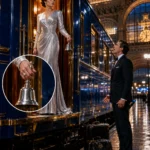
The Sovereign Limited stood beneath a glass-and-steel canopy beside the Hudson River. Morning mist curled around its wheels. The royal-blue paint was so dark it appeared black until sunlight touched it.
Workers moved along the platform carrying tool cases and inspection tablets.
No photographers waited there.
No society columnists.
No men pretending that a family could be reduced to a share price.
I climbed aboard through the rear service car.
The train smelled of lemon polish, machine oil, velvet, and cedar.
Home, in other words.
The owner’s carriage occupied the final position.
Its original name was Aurelia, after my great-grandmother. The letters had been hand-painted in gold beneath the windows.
Inside, a narrow corridor opened into a salon lined with Cuban mahogany. A marble fireplace stood between two bookcases. The ceiling had been painted midnight blue and scattered with tiny gold stars corresponding to the sky above New York on the night of the train’s first departure.
I had restored most of it myself.
Not with my hands.
The craftsmen would have laughed at that claim.
But I had located the marble quarry, negotiated for the silk, authenticated the paintings, and found the elderly grandson of the French metalworker who had designed the brass sconces.
I knew every hinge.
Every drawer.
Every scar beneath the polish.
Or I thought I did.
Adrian arrived at noon with Lena Brooks, a forensic accountant who wore red glasses and spoke about financial crimes with the calm enthusiasm of a botanist discussing orchids.
She spread bank statements across the dining table.
“Julian didn’t steal in one dramatic movement,” she explained. “He bled the restoration slowly.”
She pointed to a series of payments.
“Arden Atelier received consulting fees through four separate entities. Each stayed below the threshold requiring full board review.”
“Celeste’s company?”
“One of them. The others belong to her brother, her former roommate, and a Delaware corporation registered through an agent.”
“Directly traceable? Three point eight million. Potentially connected? Eleven point four.”
I looked at Adrian.
“You said three point eight.”
“I said what we could prove yesterday.”
Lena smiled faintly.
“Yesterday was a long time ago.”
She turned another page.
“Julian also pledged two of the restored carriages as collateral for a loan issued by Metropolitan Union Bank.”
“He couldn’t.”
“Legally, no. Physically, he signed the documents.”
“Whose approval did he use?”
“Yours.”
She slid a photocopy toward me.
My signature appeared above a notarized seal.
It was an excellent imitation.
Almost elegant.
But the final curve of the E leaned right.
I always leaned left.
“Forged,” I said.
“We believe so,” Adrian replied. “The notary claims you appeared by video conference.”
“I didn’t.”
“The conference was recorded.”
“Then it should be easy to prove.”
“The recording file was corrupted.”
Lena adjusted her glasses.
“The metadata was less cooperative with whoever corrupted it.”
A second document appeared.
The file had been created on Julian’s private laptop at 2:13 a.m. in a hotel room in Miami.
Celeste had posted a photograph from the same suite seven minutes later.
Her champagne glass stood beside the computer.
Julian’s reflection appeared in the window.
He was wearing my father’s cuff links.
I felt something inside me harden into shape.
“Can we prove he generated the forged approval?”
“We can prove his device generated the document,” Lena said. “We can prove the notary received payment from one of Celeste’s companies. We can prove the loan proceeds were transferred through accounts controlled by Julian.”
“Can we prove Celeste knew?”
“Find it.”
Lena gathered the papers.
“I like you.”
“She terrifies most people,” Adrian said.
“Most people waste time asking whether they look angry.”
I walked toward the salon.
“I am angry.”
Lena looked over the rim of her red glasses.
“No. You’re organized. That’s worse.”
After she left, Adrian found me standing beneath the painted stars.
He carried two cups of coffee.
I accepted one.
Black.
He remembered.
“Where are you staying?” he asked.
“Here.”
“On the train?”
“The Aurelia has a bedroom.”
“It also has no permanent water connection and a heating system older than either of us.”
“It has been modernized.”
“The radiators hiss like condemned men.”
“I find it soothing.”
For the first time, he smiled.
It changed his face.
Ten years disappeared.
I looked away first.
“You knew about the affair,” I said.
His smile vanished.
“Not until three months ago.”
“And you didn’t tell me.”
“I had suspicions. No proof.”
“You could have warned me.”
“Would you have believed me?”
The question was not cruel.
That made it worse.
I stared into the coffee.
Three years earlier, Adrian had sent me a brief message after Julian persuaded the board to appoint him chief executive.
**Do not give him operational control without an independent audit.**
I had shown Julian.
He had laughed and accused Adrian of jealousy.
I had agreed.
Not because I believed it.
Because agreement was easier than examining the fear beneath it.
“I might not have believed you,” I said.
“That is why I waited.”
“Was that kindness?”
He stepped beside me.
“It was cowardice.”
The honesty surprised me.
Outside, a worker tested the departure bell.
One low note rolled through the carriage.
Adrian looked toward the window.
“Your grandmother contacted me six months before she died.”
“I thought you were working for the family firm.”
“I was. She asked me to prepare the secondary trust in secret.”
“Why you?”
“She said I understood the difference between loving a thing and wanting to own it.”
My throat tightened.
“Was she talking about the train?”
His voice was quiet.
Neither of us moved.
The space between us felt crowded with everything we had not said ten years earlier.
Then my phone rang.
Julian.
I answered on the fourth vibration.
“Where are you?” he demanded.
“Good afternoon to you too.”
“You removed documents from the penthouse.”
“I removed my passport.”
“And a black portfolio from the safe.”
“The safe contained no black portfolio.”
He was breathing too quickly.
“What was in it?” I asked.
“Company materials.”
“What kind?”
“That isn’t your concern anymore.”
“The company still bears my name.”
“For now.”
I walked to the window.
On the platform below, mechanics polished the brass railing until it reflected the river.
“Why did you forge my signature?”
Silence.
Adrian turned toward me.
Julian laughed.
It was a fraction too late.
“I have no idea what you’re talking about.”
“The Metropolitan Union loan.”
“You signed that approval.”
“I was in Colorado on the date of the notarization.”
“You attended remotely.”
“From a mountain lodge without internet?”
“You’re confused.”
The familiar weapon.
Not a denial.
A diagnosis.
For years, whenever I questioned an expense, a meeting, or an inconsistency, Julian softened his voice and told me grief had made me suspicious.
After the first miscarriage, he said hormones had made me forgetful.
After my father died, he said exhaustion had made me irrational.
When I noticed Celeste’s perfume on his coat, he said trauma had made me search for abandonment.
He had turned my pain into a courtroom and appointed himself the only reliable witness.
“I’m not confused,” I said.
“You’re emotional.”
“I’m not emotional either.”
Adrian’s gaze remained on my face.
Julian lowered his voice.
“Listen to me. The press is already portraying you as unstable. Do not make this uglier than it needs to be.”
“You mean uglier for you.”
“I am trying to protect what remains of your reputation.”
“My reputation survived being married to you. It will survive the divorce.”
He inhaled sharply.
Good.
“You have no position at Vale Heritage Rail after the acquisition,” he said. “No office. No board authority. No claim to executive control.”
“Then why are you calling me?”
Another silence.
“Return the portfolio.”
“I don’t have it.”
“You’re lying.”
“No, Julian. That was your role in the marriage.”
I ended the call.
My hand trembled once.
Only once.
Adrian took the coffee cup before I spilled it.
“You should block him.”
“Why?”
“Because guilty men speak most freely when they believe they are still in control.”
That night, I slept in the owner’s bedroom.
The mattress was new, but the carved walnut frame was original. Snow began after midnight, soft against the windows. The Hudson became a black ribbon beneath the moon.
At two in the morning, I woke to a faint tapping sound.
Not at the door.
Inside the wall.
I turned on the bedside lamp.
The tapping continued as the radiator pipes warmed.
I followed the sound into the salon.
It came from behind the velvet panel beside the fireplace.
During restoration, we had removed and replaced every section of fabric in the carriage. Yet the brass trim surrounding this panel showed no tool marks.
I ran my fingers along the edge.
Near the floor, hidden beneath the velvet, was a narrow indentation.
A latch.
The panel opened soundlessly.
Behind it was a compartment no larger than a bread box.
Inside lay a leather ledger, a silver key, and a letter sealed with black wax.
I recognized my grandmother’s crest.
My name was written across the envelope.
This time, the letter contained more than nine words.
**My darling Eleanor,**
**If you have found this, then the train is nearly alive again, and someone has mistaken your patience for weakness. This happens often to women who do not perform their intelligence loudly. Let them misunderstand you. Misunderstanding is expensive.**
**The ledger contains records of assets separated from the public Vale estate. The key belongs to a deposit box at Atlantic National Bank. Adrian Cross knows the legal structure but not the contents. That was intentional. A woman should always keep one room in her life to which no man has the key.**
**There is one more thing you must understand. The Sovereign was never built merely to carry wealthy people between beautiful places. It was built to carry the family through disaster. Railroads fail. Banks collapse. Marriages end. Names become unfashionable. A movable kingdom survives.**
**Do not fight to remain where you have been humiliated. Own the road beneath the person who tried to remove you.**
**With all my love,**
**Lillian**
I opened the ledger.
The first pages listed jewelry, paintings, and investment accounts.
The middle section documented land.
Miles of it.
Parcels beneath former stations in New York, Pennsylvania, Illinois, Colorado, and California.
The final pages contained notes on something called the Meridian Reversion.
I read until dawn.
Then I called Adrian.
He arrived before seven, coat unbuttoned, snow caught in his hair.
I handed him the ledger.
For the first time since I had known him, Adrian Cross looked stunned.
“She kept this from you?” I asked.
“She kept this from everyone.”
“What is the Meridian Reversion?”
He turned the pages carefully.
“During the collapse of Vale Continental Rail, your grandmother transferred certain land corridors into long-term preservation leases. The leases remained dormant as long as no Vale passenger service operated.”
“And when service resumes?”
“The development rights return to Sovereign Meridian.”
“How much land?”
He read the notation again.
“Enough to change the valuation.”
“You said two point three billion.”
“That was before this.”
“How much now?”
“I don’t know.”
“Estimate.”
He looked up.
“Five.”
“Million?”
“Billion.”
The number did not feel real.
I sat slowly.
Julian was trying to steal a train worth perhaps forty million dollars.
He had no idea that the bell in its rear carriage could awaken five billion dollars beneath American soil.
“What is Atlantic National Bank?” I asked.
“A private bank in Connecticut. Your grandmother served on its board.”
“The key is for a deposit box.”
“We should go today.”
Adrian watched me.
“Why not?”
“Because Julian is monitoring my movements. He expected to find a black portfolio in the safe. That means he believes a physical record exists.”
“You think he knows about the ledger?”
“I think he knows my grandmother hid something. If I drive to Connecticut the day after leaving the penthouse, he will know where to look.”
“What do you propose?”
“We give him something else to watch.”
I called Julian at nine.
He answered immediately.
“I want to negotiate,” I said.
His voice changed.
Warmth returned.
Not real warmth.
The kind a hunter uses when an injured animal stops running.
“I’m glad you’re being reasonable.”
“I’ll surrender my claim to management control in exchange for the penthouse, a cash settlement, and continued use of the Aurelia carriage.”
Adrian stared at me.
Julian laughed softly.
“The carriage?”
“It matters to me.”
“That sentimental attachment is exactly why you should never have run the company.”
“Then giving it to me should cost you nothing.”
He was silent.
I could almost hear him calculating.
“I’ll have my attorneys prepare terms,” he said.
“Send them to Adrian Cross.”
The warmth disappeared.
“You’re working with Cross?”
“He represents the trust.”
“He wants you.”
His expression did not change, but something dangerous entered his eyes.
“Does that concern you?” I asked.
“It should concern you. Men like Cross do not help women without expecting payment.”