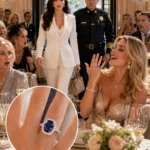
My grandmother’s ring.
For a moment, the beach disappeared.
All I saw was Beatrice Whitcomb’s hand resting on a silver cane, that ring catching the light as she signed documents men prayed she would not understand.
Grant had taken it from the blue velvet case in my dressing room.
Not borrowed.
Not inherited.
Taken.
I felt something inside me go utterly still.
It was not rage.
Rage moves.
This was deeper.
This was the floor dropping out and revealing steel beneath.
Grant finally saw me.
His smile tightened, then returned.
He was good.
I will give him that.
He walked toward me with the relaxed charm he used when a waiter brought the wrong wine in front of important people.
“Nora,” he said warmly.
As if I were late to a dinner, not arriving at my own public execution.
“I’m glad you decided to join us.”
I stopped three feet from him.
Three feet is important.
Close enough to hear.
Far enough not to be touched.
“I wasn’t invited.”
The guests went silent.
Grant’s jaw flexed.
“Don’t start.”
I looked past him at Sloane.
She was smiling again, but her fingers had curled around the stem of her champagne glass.
“Mrs. Hawthorne,” she said.
She said it sweetly.
She said it as if the title already smelled stale.
“Which one?” I asked.
A low ripple passed through the guests.
Grant’s face hardened.
Sloane recovered first.
“I’m sorry this is painful for you.”
“No, you’re not.”
Her smile flickered.
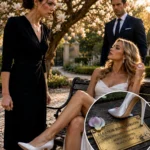
I looked at the sign.
The gold paint shimmered under the sinking sun.
“Who put that there?”
Sloane raised her chin.
“I did.”
“Did you?”
Grant stepped between us.
“This is unnecessary.”
“I agree.”
His shoulders loosened slightly.
He thought I meant the confrontation.
I meant the sign.
“This land is part of the Whitcomb Coastal Trust,” I said.
“The beach, the dune path, the terrace, the east lawn, the guest wing, the road you all used to arrive, and the house behind you belong to that trust.”
Someone near the bar whispered, “Oh my God.”
Grant laughed under his breath.
It was an ugly little sound.
“Nora, don’t be dramatic. We’re married.”
I looked at him.
“We are.”
He lowered his voice.
“You’re embarrassing yourself.”
“No, Grant.”
I glanced toward the photographer, who had stopped taking pictures but had not stopped listening.
“You did that when you threw an engagement party for your mistress on property you have no right to use.”
The word mistress landed hard.
Sloane’s cheeks flushed.
Grant stepped closer.
“I told you this would be easier if you accepted reality.”
“What reality is that?”
“That this marriage is over.”
The pain came then.
Not loudly.
Not visibly.
Just a slow bloom behind my ribs.
Seven years reduced to a sentence on a beach.
I let myself feel it for one breath.
Only one.
Then I folded it away.
“You’re right,” I said.
Grant blinked.
He had expected resistance.
Begging, perhaps.
Or cold negotiation.
Not agreement.
I turned to Everett.
He opened the deed binder.
There was something wonderfully theatrical about paper in that moment.
No shouting could have matched it.
No insult could have cut deeper than Everett placing a certified copy of the trust deed on a cocktail table between two champagne buckets.
“This is the recorded deed for Gray Harbor and its coastal parcel,” I said.
“For clarity, the trust has never transferred, leased, licensed, or granted naming rights to Grant Hawthorne, Sloane Mercer, Hawthorne Cellars, Hawthorne Shore Club LLC, or any person standing on this beach tonight.”
The party had gone so quiet I could hear the water pulling stones beneath the surf.
Sloane looked at Grant.
Grant did not look at her.
That was when she first understood he had sold her a stage he did not own.
“Grant said this was his family property,” she said.
Her voice had lost its honey.
“Grant says many things.”
Grant pointed at Everett.
“Get him out of here.”
Everett did not move.
I almost laughed.
“You cannot order my estate manager off my estate.”
His face flushed dark.
“Your estate?”
“My trust’s estate.”
“It’s marital property.”
I let the word hang.
Then I gave him the kindest smile I had left.
“It was never marital property.”
Sloane’s eyes darted to the guests.
She could survive being disliked.
She could not survive being made ridiculous.
“This is still a private event,” she said sharply.
“No,” I said.
“It is now evidence.”
That word did what humiliation could not.
It sobered the rich.
One by one, guests began looking at their phones, their spouses, the path back to the house.
Grant’s voice dropped.
“Nora.”
There it was.
The warning.
The plea disguised as a command.
I looked at him and saw the man from the cathedral.
The man from the hospital room.
The man from the dining table.
The man pouring champagne for another woman under my grandmother’s sky.
And finally, I saw him clearly.
Not as the villain of my life.
As a trespasser.
“Everett,” I said.
“Yes, Mrs. Hawthorne.”
“Remove the sign.”
Two security guards in navy jackets walked down from the dune path.
Sloane stepped in front of the sign.
“Don’t touch it.”
One guard paused.
I looked at her.
“That sign is installed on protected dune-adjacent trust property without permission.”
“It’s just a sign.”
“It is also a false commercial representation and, given the photographs being taken, part of a documented attempt to misappropriate trust property for a private venture.”
She stared at me.
For the first time, she looked her age.
Young.
Scared.
Mean.
Grant moved toward me.
“You vindictive—”
“Careful,” I said.
He stopped.
Not because he respected me.
Because the cameras were still rolling.
I nodded to security.
They pulled the sign from the sand.
It came loose with a soft wooden crack.
Sloane flinched as if they had removed a crown from her head.
I turned to the crowd.
“Ladies and gentlemen, Gray Harbor is closed for the evening.”
No one moved at first.
Wealthy people are not used to being dismissed unless someone is dead or dinner is over.
“The cars will be brought around,” I continued.
“Any photographs taken on trust property tonight may be requested in connection with pending legal action.”
That worked.
The party dissolved like sugar in hot tea.
Guests gathered shoes, wraps, handbags, dignity.
The quartet packed silently.
The bartender looked relieved.
A woman I knew from the Preservation Society touched my arm as she passed.
“Nora,” she whispered.
She lowered her eyes and kept walking.
That, somehow, hurt too.
Not because she left.
Because she had known.
So many people had known enough to come.
Grant watched the guests climb the dune path.
His face had gone empty.
When the last champagne bucket was lifted away, only three of us remained near the water.
Me.
My husband.
His future wife.
Sloane’s bare feet were sinking slightly into the sand.
She looked at Grant.
“Do something.”
He looked at me.
“Nora, we need to talk privately.”
I smiled faintly.
“Now you want privacy?”
He swallowed.
The wind moved through his shirt.
Sloane lifted her hand, and my grandmother’s ring caught the last orange light of the sun.
I looked at it.
“Take off the ring.”
Her hand closed.
Grant said my name sharply.
I took one step toward Sloane.
“That ring is not Grant’s to give.”
“He said it was a family heirloom.”
“It is.”
I held her gaze.
“Mine.”
Silence.
Then Sloane looked at Grant.
His mouth opened.
Nothing came out.
It was the first honest thing he had said all evening.
I extended my hand.
“Take it off.”
Her eyes filled with hatred.
Not shame.
Hatred.
Women like Sloane do not hate men who lie to them.
They hate women who prove it.
Slowly, she pulled the ring from her finger.
She dropped it into my palm.
It was warm from her skin.
I closed my fingers around it.
Then I looked at Grant.
He looked older already.
I said, “Remove the sign. Then the guests. Then him.”
Everett nodded once.
Security stepped forward.
Grant stared at me as if I had slapped him.
“You can’t throw me out of my own marriage.”
“But I can revoke access to trust property.”
“This is insane.”
I looked at the empty beach, the trampled roses, the champagne stains darkening the sand.
“This is documented.”
Part 4: The Tide Turns in a Room Without an Ocean View
The next morning, my face was on the internet.
Not crying.
Not screaming.
Not collapsing into the surf.
Walking down the beach in black silk while my husband’s mistress stood beside a sign that made half of America choose a side before breakfast.
Someone had leaked a clip.
Not me.
I would have chosen better lighting.
The video began with Grant saying, “Nora couldn’t join us tonight. She’s still a little bitter about the transition.”
Then the camera panned just in time to catch me descending the dune path with Everett and the deed binder.
By noon, the comments had turned brutal.
Future Mrs. Hawthorne’s Shore became a meme.
People stitched it with videos of women standing in front of houses they owned, cars they paid for, businesses they built.
One woman held up a mortgage statement and said, “Future Mrs. Johnson’s Kitchen? Baby, I am the bank.”
Another stood in a cornfield and said, “He said it was his farm. My granddaddy said otherwise.”
The internet is cruel.
For once, it was not cruel to me.
Grant called thirty-seven times before 10 a.m.
I did not answer.
Sloane posted one statement.
Out of respect for all parties, I ask for privacy during this deeply personal transition.
It stayed up for nineteen minutes before people filled the comments with deed jokes.
Then she deleted her account.
I spent the morning in Providence, in a conference room with no ocean view, wearing a cream suit and my grandmother’s ring.
Across from me sat my attorney, Lydia Crane.
Lydia was sixty, brilliant, and famous for making men regret underestimating quiet women.
Beside her was a litigation partner, a forensic accountant, and Dean Alvarez, the investigator.
At the far end of the table sat Grant, his attorney, his mother Celeste, and the family’s corporate counsel.
Celeste wore pearls the size of small moons and a navy dress that made grief look hereditary.