She did not look at me when I entered.
Grant did.
He looked like he had not slept.
There are some lessons rest should not soften.
Lydia opened the folder in front of her.
“Thank you all for coming on short notice.”
Grant’s lawyer cleared his throat.
“We are here voluntarily and without waiving any rights.”
“Of course,” Lydia said.
Lawyers smile before surgery.
“We’ll begin with Gray Harbor.”
Celeste finally spoke.
“This family has been through enough public embarrassment.”
“So has mine.”
Her eyes sharpened.
“Nora, dear, no one wanted this.”
That was Celeste’s gift.
She could turn a knife into weather.
As if betrayal had simply happened, like rain.
I placed my handbag on the table.
“Your son hosted a commercial event with his mistress on my family’s trust property and announced a business venture using assets he does not own.”
Grant leaned forward.
“It wasn’t commercial.”
Lydia slid a document across the table.
“Hawthorne Shore Club LLC, registered in Delaware eight weeks ago.”
Another document.
“Draft membership deck.”
Another.
“Projected revenue from Gray Harbor launch event.”
“Wire transfer from Hawthorne Cellars marketing account to Mercer Brand Strategy.”
The room changed temperature.
Grant looked at the document.
Then at Sloane’s empty chair.
She had not come.
Smart woman.
Or cowardly.
Sometimes those look the same from a distance.
Grant’s attorney began reading.
Celeste’s lips pressed together.
Lydia continued.
“Mr. Hawthorne, did you authorize company funds for last night’s event?”
Grant said nothing.
His attorney answered.
“We will review.”
“Please do.”
Lydia opened another folder.
“We will also review the use of Mrs. Hawthorne’s image and reputation in investor communications.”
Grant’s eyes snapped to mine.
“What does that mean?”
Dean Alvarez placed a transcript on the table.
The Markham Club dinner.
Grant’s face drained slowly as he read his own words.
My wife has always preferred paperwork to people.
The beach will have a new Mrs. Hawthorne.
The Whitcomb estate will finally enter the Hawthorne legacy.
He looked up.
“You recorded a private dinner?”
Dean spoke calmly.
“The venue records certain rooms for security purposes, with disclosure in the membership agreement. A guest provided the transcript voluntarily after your remarks became relevant to financial solicitation.”
Grant’s lawyer closed his eyes briefly.
Celeste looked at her son with something worse than anger.
Calculation.
She was no longer asking whether he had hurt me.
She was asking how much he had cost them.
That was the Hawthorne way.
Lydia moved on.
“Now to the marital agreement.”
Grant laughed once.
It sounded broken.
“You’re really going to use the prenup?”
“You used it.”
He stared at me.
“You made every clause relevant.”
Lydia did not need to raise her voice.
That was why I liked her.
“Section 9: infidelity involving marital or company funds.”
She placed invoices on the table.
“Section 11: reputational harm connected to public misrepresentation.”
She placed screenshots on the table.
“Section 14(c): unauthorized use or attempted use of Whitcomb Trust property for personal, romantic, commercial, or promotional purposes.”
She placed the beach photographs on the table.
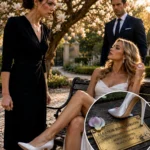
The sign gleamed obscenely even on paper.
“Section 17: revocation of residency and access to trust-controlled homes upon breach.”
Grant’s attorney finally spoke.
“Mrs. Hawthorne is escalating emotionally.”
I tapped the folder.
“I’m escalating contractually.”
For the first time that day, Lydia almost smiled.
Then came the ring.
A photograph from my dressing room safe.
A copy of the trust inventory.
A security log showing Grant entering the dressing suite while I was in Providence.
A close-up from Sloane’s own party photographs, the diamond bright on her finger.
Celeste looked at the image and went pale.
She recognized the ring.
Everyone in our circle knew that ring.
It had been on my grandmother’s hand when she faced down a board of men trying to force a sale of the Whitcomb docks in 1987.
It was not jewelry.
It was history.
Grant whispered, “I was going to put it back.”
“You gave it to another woman.”
“I needed something meaningful.”
The sentence sat there, monstrous and small.
Something meaningful.
As if meaning were an object he could steal when he ran out of sincerity.
I leaned forward.
“Do you understand what you did?”
For one second, I saw him almost answer as a husband.
Then pride returned.
“I made a mistake.”
I shook my head.
“A mistake is forgetting a birthday.”
I picked up the photograph of Sloane’s hand.
“This is theft wearing romance.”
Celeste’s voice cut in.
“Grant, tell me there is no police report.”
That was the first time Grant looked afraid.
Real fear does not make men loud.
It makes them young.
He turned to me.
“Nora, please.”
The first please.
Not at the hospital.
Not at the dining table.
Not on the beach.
Here.
In a conference room.
When money entered the room with a witness.
I felt no triumph.
That surprised me.
I had imagined victory would feel like champagne.
It felt more like closing a window before a storm came in.
Lydia slid the final folder forward.
“Now, Hawthorne Cellars.”
Grant stiffened.
“This meeting isn’t about the company.”
“It is now,” I said.
His attorney frowned.
“Mrs. Hawthorne has no standing in Hawthorne Cellars management.”
Lydia looked at me.
I nodded.
She opened the folder.
“Argent Tide Holdings currently owns sixty-one percent of Hawthorne Cellars voting shares through debt conversion instruments executed over the last thirty-four months.”
The corporate counsel went still.
Grant stared at Lydia.
“What?”
Celeste’s hand tightened around her pen.
“Argent Tide is wholly owned by the Whitcomb Coastal Trust.”
I watched Grant understand in pieces.
First the company.
Then the debt.
Then the meetings where he had complained about me while sitting beneath the roof my money had kept from collapsing.
Then the investor dinners.
Then the way he had spoken about my paperwork.
His eyes found mine.
“You?”
“You bought my company?”
“I saved it.”
He looked as if I had struck him harder than any insult could.
Men like Grant can survive being hated.
They cannot survive owing everything to the woman they called small.
Celeste’s voice was barely audible.
“How long?”
“Long enough,” I said.
The corporate counsel started flipping through pages.
He was looking for a loophole.
There was none.
My grandmother had trained better lawyers than his.
Lydia said, “The board has been notified of misconduct, misuse of corporate funds, and reputational exposure created by Mr. Hawthorne’s personal actions and unauthorized commercial representations.”
Grant stood so abruptly his chair hit the wall.
“You can’t remove me.”
I looked up at him.
His face was red.
His hands were shaking.
There had been a time when that would have made me reach for him.
There had been a time when I would have cared that he was falling apart.
But women are not born cold.
We are cooled.
Slowly.
By empty hospital rooms.
By public smiles.
By men who confuse our patience for permission.
“You are suspended pending board review,” I said.
No sound came.
“And Grant?”
“The company car was collected this morning.”
Celeste closed her eyes.
That was how I knew the blow landed.
Not the beach.
Not Sloane.
The car.
Status has strange gods.
Grant sat down slowly.
His attorney whispered to him.
Celeste turned to me at last.
“Nora, surely we can settle this quietly.”
I studied her.
For seven years, Celeste Hawthorne had corrected my flower arrangements, my seating charts, my charitable priorities, my pronunciation of French villages she had never visited.
For seven years, she had called me dear with the warmth of a locked gate.
For seven years, she had accepted my money while mourning that her son had married beneath the romance he deserved.
“Quietly?” I asked.
Her voice softened.
“For the sake of the family.”
“There it is.”
She blinked.
“The family.”
I placed both hands flat on the table.
“Your family wanted my silence when Grant missed my miscarriage.”
Grant flinched.
“Your family wanted my money when the company failed.”
Celeste looked away.
“Your family wanted my house for Sloane’s launch.”
The room did not move.
“So no, Celeste.”
My voice stayed calm.
“We will not confuse your comfort with dignity.”
Lydia closed the folder.
“Mrs. Hawthorne’s terms have been delivered.”
Grant looked at me.
“What terms?”
“Divorce under the prenup,” I said.
“Immediate departure from all Whitcomb properties.”
“Resignation from executive duties pending investigation.”
“Return of all trust property.”
“Full reimbursement of company funds used in connection with Ms. Mercer.”
“Public clarification that Gray Harbor, the beach, and all related marks were never Hawthorne assets.”
He stared.
“That will ruin me.”
I did not say what he deserved.
I did not say what he had ruined.
I simply stood.
I picked up my handbag.
“You did that before I entered the room.”
Part 5: The Man Who Arrived Too Late
The rain came three nights later.
Not dramatic rain.
Not movie rain.
Cold coastal rain that tapped against the windows of Gray Harbor and turned the terrace stones black.
I was in my grandmother’s study, sorting through trust correspondence, when Margo knocked softly.
I looked up.
“Mr. Hawthorne is at the gate.”
Of course he was.
Men like Grant never arrive for the breaking.
Only the consequences.
I looked toward the window.
Beyond the glass, the ocean was invisible, but I could hear it.
“Is he alone?”
“Has he been drinking?”
“Security says no.”
“Let him through to the north porch.”
Margo hesitated.
“Not inside?”
Inside was for people who had not tried to give my home to another woman.
I found Grant under the porch light, soaked at the shoulders, his hair dark from rain.
He looked less handsome without the architecture of power around him.
No valet.
No champagne.
No mother.
No mistress.
Just a man standing outside a locked house.
There was a time when the sight would have undone me.
That time had passed, but not without leaving scars.
He saw me through the glass door.
For a second, neither of us moved.
Then I opened it.
The cold air entered first.
“Nora,” he said.
His voice was hoarse.
“Grant.”
He looked behind me, into the warm hall, the old paintings, the polished floor.
His eyes lingered on the place he had treated as his by proximity.
“I need to come in.”
“I just want to talk.”