“You waited until tonight to maximize humiliation.”
I looked at the audience.
The donors.
The trustees.
The cameras.
The woman beside my grandmother’s piano.
“Humiliation requires innocence.”
His jaw flexed.
For a moment, I thought he might cross the stage and strike me again.
Then he noticed the detective near the front doors.
Recognition entered his eyes.
He touched his cuff.
A nervous gesture.
The detective stepped forward.
“Mr. Blackwell, we need to speak with you concerning an incident reported this morning.”
Adrian looked toward my cheek.
The makeup hid most of the bruise.
Not all of it.
A woman in the first row gasped.
Camille turned to him.
“What incident?”
He ignored her.
“Vivienne,” he said.
The way he spoke my name was different now.
Not loving.
Not angry.
Afraid.
“Do not do this.”
I almost smiled at the absurdity.
He had spent years dismantling my career, forging my signature, stealing from my family, and preparing to declare me incompetent.
Yet in the final second, he still believed the destruction belonged to me.
“I did not do this,” I said.
“You did.”
The detective asked him to step away from the stage.
Adrian remained still.
Then Camille moved.
She came down from the piano platform and faced him.
“You said the archive belonged to Halcyon.”
“It does.”
“The court says it does not.”
“The court can be challenged.”
“You said the company was privately capitalized.”
“It is.”
“With donor money?”
“Camille, not now.”
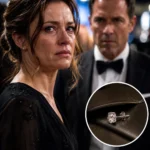
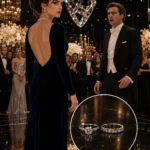
She pulled one diamond earring free.
“You said these were from a donor collection.”
He said nothing.
Her hand trembled as she removed the other.
“You said the villa was ours.”
A deeper silence fell.
Adrian’s eyes sharpened.
“That is irrelevant.”
“Is it?”
She looked toward the screen.
“Show her,” I told Julian.
He hesitated.
“She deserves to know the role he wrote for her.”
The screen changed.
The Lake Como trust appeared.
Camille searched the page.
Her name was nowhere on it.
Beneficiary: Lucas Vale.
Her lips parted.
“Who is Lucas?”
Adrian looked at me with pure hatred.
“That information is sealed.”
“Not from the person you persuaded to help commit fraud.”
Camille stared at him.
“A child,” I said. “His child.”
The words seemed to strike her physically.
She took one step back.
“You told me you never wanted children.”
Adrian’s composure finally shattered.
“Stop talking.”
The command echoed through the ballroom.
Camille flinched.
Then something in her face changed.
Not heartbreak.
Recognition.
She was seeing him clearly for the first time.
Perhaps I should have hated her.
Part of me did.
She had sat at my piano.
Worn my mother’s diamonds.
Helped forge the document meant to erase me.
But there was a difference between forgiveness and accuracy.
Camille had not defeated me.
She had been recruited into the same machine.
The only difference was that Adrian had promised her a better seat.
“You said she was ill,” Camille whispered. “You said she had abandoned you. You said she wanted the arrangement.”
I looked at her.
Tears brightened her eyes, but she refused to let them fall.
Adrian laughed bitterly.
“Do not pretend innocence now.”
Camille turned toward him.
“I gave you everything.”
“No. You gave me access.”
The cruelty was effortless.
It stripped the final illusion from the room.
Camille reached behind her neck and unclasped a diamond bracelet.
Another piece from my mother’s collection.
She placed the jewelry on top of the piano.
Then she looked at me.
“I am sorry.”
The apology did not repair anything.
But it cost her something to say it.
I nodded once.
The detective approached Adrian again.
“Sir, come with me.”
Adrian looked around the ballroom.
At the trustees who would not meet his eyes.
At the donors already whispering to attorneys.
At Dr. Whitmore holding the institution he believed he controlled.
At Camille standing beside jewelry that had never belonged to her.
Finally, at me.
“You think they will respect you after this?” he said. “You destroyed your husband in public.”
I touched the sapphire at my throat.
“My husband destroyed himself in public.”
The detective placed a hand near Adrian’s arm.
He pulled away.
“I know how the Hart Trust works,” he said. “You cannot move the archive without board cooperation. You cannot operate the west wing without Halcyon. You have paper ownership of rooms inside my institution.”
Julian’s expression changed.
Not surprise.
Satisfaction.
He had been waiting for that sentence.
I opened the folder to the final document.
“Hestia Cultural Holdings owns the mortgage beneath Halcyon’s west wing.”
Adrian frowned.
“So?”
“Hestia exercised its acceleration rights this afternoon.”
Dr. Whitmore turned toward me, though she already knew.
“Halcyon had until eight thirty tonight to cure twenty-seven million dollars in unauthorized encumbrances created through your shell companies.”
Adrian’s face emptied.
“You cannot be serious.”
“The cure period expired sixteen minutes before Camille finished my solo.”
The audience murmured.
I lifted the final page.
“As of tonight, Hestia controls the west wing, the archive vaults, the recital hall, and every administrative office constructed under the 1983 expansion agreement.”
The recital hall.
The room we were standing in.
Adrian looked up at the chandeliers as though they had betrayed him too.
“You do not own Halcyon.”
I let the silence sharpen.
“Only the part with your office.”
A laugh escaped from somewhere in the audience.
Then another.
Adrian heard them.
Humiliation changed his face in a way rage never had.
He had survived accusation.
He could not survive being ridiculous.
The detective escorted him toward the doors.
As he passed me, he lowered his voice.
“You will regret this when you are alone.”
Julian stepped closer, but I answered first.
“I was alone while I was married to you.”
Adrian stopped.
The detective guided him forward.
The ballroom doors opened.
Cold air entered from the marble foyer.
Cameras flashed.
Then my husband disappeared through the crowd he had assembled to worship him.
For several seconds, no one moved.
Dr. Whitmore returned to the microphone.
“The recital is suspended.”
She looked at me.
I turned toward Camille.
She stood beside the piano, stripped of diamonds, applause, and certainty.
“You prepared the full sonata,” I said.
Her voice shook.
“Then finish it.”
The room stirred.
Camille stared at me.
“Because the music did not betray me.”
Her chin trembled.
“And neither should we betray it.”
She looked toward the doors through which Adrian had vanished.
Then she sat at the piano.
This time, when she placed her hands on the keys, she did not look triumphant.
She looked human.
The second movement began softly.
Its opening lines rose beneath the chandeliers, no longer sharp with conquest.
I returned to my seat.
Julian sat beside me.
“You surprise me,” he said.
“I thought you knew everything.”
“Only the evidence.”
His hand rested on the chair between us.
Not touching mine.
Close enough that I could feel the warmth.
Onstage, Camille played more beautifully than she had before.
Pain had entered the music.
So had humility.
Neither erased what she had done.
But truth rarely arrived clean.
Sometimes it came wearing another woman’s dress.
Sometimes it sat at your grandmother’s piano and finished the piece.
When the sonata ended, the applause was quieter.
Not weaker.
Honest.
Camille stood and bowed.
Then she left the stage without looking at anyone.
The lights above the donor tables brightened.
The evening was over.
Or so everyone believed.
Julian turned to me.
“You have one more announcement.”
I looked at the black folder in my lap.
The final document remained hidden beneath the court orders.
My grandmother’s last secret.
The one even Adrian had not discovered.
“Yes,” I said.
“One more.”
## CHAPTER FIVE
## THE LAST NOTE BELONGED TO ME
By morning, the story had escaped Boston.
Clips from the recital flooded social media.
Adrian’s speech about my lack of courage.
Dr. Whitmore’s correction.
The forged waiver.
Thomas Bell admitting he believed it was legal.
Camille discovering that the villa had never been hers.
And finally, my announcement that I owned the west wing containing Adrian’s office.
The internet gave the scandal names before breakfast.
The Halcyon Coup.
The Steinway Reckoning.
The Wife in Black.
My least favorite was Symphony of Revenge.
Revenge had not felt like music.
It had felt like bookkeeping performed with a broken heart.
The videos received millions of views.
Commentators praised my composure. Strangers analyzed the movement of my eyes, the angle of Adrian’s shoulders, the exact second Camille understood she had been lied to.
Women wrote that they recognized the language he used.
Not herself.
Thousands shared stories of husbands, employers, parents, and doctors who had turned concern into a cage.
That mattered more to me than the headlines.
Adrian was released pending arraignment on the assault charge, but the financial investigation expanded quickly.
The Massachusetts Attorney General’s office froze Blackwell Arts Media’s domestic accounts.
Federal investigators began tracing funds across state lines.
Halcyon placed Adrian on immediate unpaid suspension, then terminated him two days later.
Thomas Bell resigned before the board could remove him.
Rebecca Sloane surrendered her notarial records through counsel.
Camille disappeared from public view.
I filed for divorce.
Adrian contested everything.
Of course he did.
He claimed the recital evidence had been manipulated.
He called the trust reversion vindictive.
He insisted the assault video lacked context.
He accused Julian of conspiring to break our marriage for personal gain.
That accusation appeared in a legal filing forty-eight hours after the recital.
I read it in Julian’s office.
“He knows,” I said.
Julian stood at the window, looking over the harbor.
“He suspects.”
“About Lenox?”
“Perhaps.”
“There was nothing after Lenox.”
“I am aware.”
“Does it matter?”
“To the divorce? No. To the press? Possibly.”
I watched him.
He had slept very little since the recital. His tie was loosened. A shadow darkened his jaw. For the first time in weeks, he looked less like an attorney and more like the man who had kissed me beneath a cedar tree.
“What does it matter to you?” I asked.
His gaze returned to mine.
“That depends.”
“On what?”
“Whether you are asking as my client.”
I closed the legal filing.
The room became quiet.
Julian walked toward me.
He stopped on the opposite side of the desk, leaving its polished mahogany width between us.
“I loved you before Adrian,” he said.
No hesitation.
No decoration.
The truth arrived with terrifying simplicity.
“I probably loved you after him too.”
My throat tightened.
“Probably?”
“I am attempting professional caution.”
Despite everything, I laughed.
His expression softened.
Then he continued.
“But I will not become the reward at the end of your suffering. And I will not ask you to replace one marriage with another story before you have decided who you are without either of us.”
The tenderness of that refusal nearly undid me.
Adrian had always called possession love.
Julian offered distance and somehow made it feel intimate.
“I do not know who I am yet,” I said.
“Yes, you do.”
“You said I needed to decide.”
“You need to decide what you want. Who you are has been obvious for a long time.”
“To everyone except me.”
“That is often how survival works.”
I looked down at my hands.
“I am afraid I will mistake gratitude for love.”
“So am I.”
“And if it is not gratitude?”
“Then it will still be true later.”
He came around the desk.
For one breath, I thought he might kiss me.
He did not.
He lifted my hand and pressed his lips to my knuckles.
The gesture was old-fashioned.
Restrained.
More devastating than hunger.
“When you are free,” he said, “ask me again.”
Then he released me.
That afternoon, I returned to Halcyon.
The west wing had been closed temporarily while investigators reviewed financial and digital records. Security seals covered Adrian’s office door.
I stood outside it alone.
For years, I had waited in that office while he finished calls.
I had sat on the velvet sofa and watched him sign programs with my family’s fountain pen.
I had listened as he explained my own institution to me.
Now his name had been removed from the brass plaque.
Only four pale holes remained.
Dr. Whitmore joined me.
“The board approved the restructuring,” she said.
“Unanimously?”
“All but one abstention.”
“Who?”
“Gerald Voss. He fears the trust will dominate Halcyon.”
“He may be right to fear it.”
She studied me.
“You do not intend to absorb the conservatory?”
“Then what do you intend?”
I looked down the corridor.
Students moved between practice rooms carrying violin cases, scores, coffee cups, and private dreams.
“Separate the archive legally and financially. Restore Halcyon’s independence. Create public oversight for restricted donations. Protect scholarships from administrative retaliation.”
Dr. Whitmore nodded.
“And the west-wing debt?”
“Hestia will forgive half in exchange for governance reform.”
Her eyes widened.
“That is more than thirteen million dollars.”
“My grandmother did not build leverage to collect interest. She built it to prevent men like Adrian from confusing stewardship with ownership.”
Dr. Whitmore was silent.
Then she asked, “Will you take the board chair?”
“Why not?”
“Because I have spent too long living inside rooms where power depended on one person.”
“What role will you take?”
I looked toward the archive doors.
“Custodian.”
The word felt better than owner.
The archive reopened six weeks later under a new nonprofit foundation.
The Helena Hart Center for American Music would preserve the collection, digitize rare scores, fund women composers, and provide free public access to selected recordings.
Halcyon students would retain research privileges.
No luxury hotel would receive naming rights.
No private company would use my grandmother’s piano as collateral.
The first major exhibition was scheduled for spring.
Its title came from a line in Helena’s letter.
Beautiful Things Remember the Truth.
Camille contacted me two months after the recital.
Her message contained no excuses.
Only a request to meet.
We chose a quiet café in Providence, far from Boston photographers.
She arrived without makeup, wearing a gray coat and no jewelry.
For the first few minutes, neither of us touched our coffee.
Then she slid an envelope across the table.
“What is this?” I asked.
“Everything I kept.”
Inside were printed emails, account numbers, travel receipts, and an encrypted drive.
“I already gave investigators my phone,” she said. “These are backups Adrian did not know about.”
“Why did you keep backups?”
Her mouth twisted.
“Because some part of me knew.”
“Knew what?”
“That a man who asked me to help erase his wife might someday erase me.”
“That did not stop you.”
She accepted the judgment without flinching.
“I wanted what you had.”
“My husband?”
“Your life.”
I almost laughed.
She continued.
“The house. The name. The invitations. The way people became quiet when you entered a room. Adrian told me you had wasted all of it.”
“And you believed him.”
“I wanted to.”
There was no self-pity in her voice.
Only shame.
“He said you were cruel to him. That you refused affection. That you used your family name to belittle him. That you had abandoned music but would not let anyone else succeed.”
“Did you ever ask me?”
“Because then I might have heard the truth.”
Outside the café window, rain darkened the sidewalk.
Camille wrapped both hands around her cup.
“I am not asking you to forgive me.”
She nodded.
“I resigned from the recording contract. I will testify about the waiver and the archive photographs.”
“What about your sister?”
“She says Adrian pressured her. That is partly true. She also wanted the money.”
“And you?”
“I wanted the stage.”
For the first time, her eyes filled.
“He told me that once I played your solo, the room would forget you.”
I thought of her hands on Helena’s piano.
The brief smile she had given me.
“Did you believe that?”
“And now?”
Camille looked down.
“Now I think rooms remember the person who built them.”
I took the encrypted drive.
Before leaving, she paused beside the table.
“There is something else,” she said.
“The night before the recital, Adrian made a call from my apartment. He thought I was asleep.”
“To whom?”
“A banker in Switzerland.”
I went still.
“What did he say?”
“He said if the vote failed, he would trigger ‘the second Hart instrument.’”
“What instrument?”
“I do not know. But he said it was worth more than the archive.”
The second Hart instrument.
I called Julian before Camille reached the door.
Within three days, Mercer & Locke found the reference.
It was buried in a private memorandum attached to my grandmother’s trust.
Not an instrument in the musical sense.
A financial instrument.
A century-old portfolio of railroad shares, land royalties, mineral interests, and private bonds that Helena had consolidated into a dormant family vehicle called the Hart Continuity Fund.
The fund’s records had disappeared from conventional reporting after a bank merger in the 1980s.