My husband introduced his mistress as the visionary behind my climate-technology company.
He did it beneath a ceiling made of smoked glass and suspended crystal, in front of three hundred investors, journalists, politicians, and people who had once begged me to take their money.
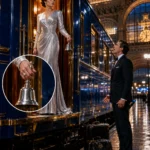
Sloane Mercer stood beside the LumenCell prototype in a silver gown that looked poured over her body. The battery module behind her was enclosed in museum glass, illuminated from below like a royal jewel.
My royal jewel.
My twelve years of research.
My scarred fingertips.
My sleepless nights.
My father’s final investment.
My name, quietly removed from the evening’s program.
“The future doesn’t belong to those who are afraid of risk,” Sloane said, smiling into the cameras. “It belongs to those brave enough to build abundance.”
The applause came instantly.
I almost admired her delivery.
The sentence had been copied word for word from page seventeen of my private investor deck.
A document only four people had permission to open.
I stood near the back of the ballroom in a black silk dress with no jewelry except my wedding ring. Julian had assigned me a seat at a side table beside the hotel’s emergency exit, as though I were an inconvenient former employee instead of the woman who had founded Asterion Energy in a rented laboratory twelve years earlier.
Onstage, my husband placed one hand against the small of Sloane’s back.
Not low enough to create a scandal.
Just low enough to tell me the scandal had already happened.
Julian Vale had always understood the exact distance between cruelty and plausible deniability.
“My wife was essential during Asterion’s early years,” he said.
Early years.
As though I had poured coffee while the real work was being done.
A murmur moved through the audience.
Several people turned to look at me.
Some with pity.
Some with hunger.
Public humiliation is a form of entertainment among the wealthy. They pretend to dislike blood, but they will pay extraordinary amounts of money for a seat close enough to see it.
Julian’s expression softened into the look he used whenever he was preparing to destroy someone politely.
“Unfortunately, Evelyn lost the courage to innovate,” he continued. “She became trapped by caution. Asterion needed a new imagination. Sloane gave us one.”
The cameras found my face.
I did not look away.
I did not cry.
I did not stand.
May you like
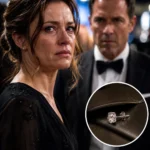
I simply watched the man I had loved hand my life’s work to the woman wearing the earrings he had bought with money stolen from my company.
Behind them, the enormous presentation screen displayed a countdown.
**FIVE MINUTES UNTIL THE LUMENCELL PATENT REVEAL.**
Julian believed the screen would confirm Asterion’s ownership.
Sloane believed it would make her immortal.
The board believed I had come to witness my own replacement.
None of them knew the prototype was resting on technology Asterion had never legally owned.
None of them knew that seventeen minutes earlier, the company’s largest secured creditor had transferred its position to a private trust.
None of them knew the signature Julian had forged three years ago had finally become more valuable than the marriage he had used it to betray.
I looked down at my wedding ring.
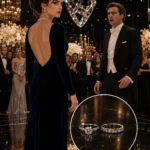
Then I slipped it from my finger and placed it in my champagne glass.
Across the ballroom, Julian saw me.
For the first time that evening, his smile faltered.
The countdown continued.
And I waited.
# CHAPTER ONE
## The Woman They Mistook for Decoration
Seventy-two days before the launch, I discovered my husband was sleeping with Sloane because of a thermal-imaging camera.
Not because I was spying.
Because I was working.
At 2:13 on a Thursday morning, I was sitting alone inside Asterion’s Battery Safety Lab in Brooklyn, watching heat signatures spread across a test module.
The laboratory was kept at sixty-four degrees. Julian hated visiting because he said the cold made the building feel unfinished. He preferred the forty-seventh-floor executive suite in Manhattan, where the conference tables were Italian marble and the employees spoke softly around him.
I preferred places where expensive lies could catch fire.
The module on my screen was a preproduction LumenCell unit: a grid-scale battery designed to store renewable energy without lithium, cobalt, or the supply chains that had made clean technology dependent on dirty extraction.
The first LumenCell had been the size of a refrigerator and about as elegant as a car accident. This one was sleek enough to display in a gallery. Its shell was matte black ceramic. Its core used an iron-sodium matrix I had developed in graduate school and spent more than a decade stabilizing.
If it worked, it could change how cities stored power.
If it failed, it could turn a warehouse into an oven.
At 2:14, cell C-19 spiked by eight degrees.
At 2:15, the internal separator began to deform.
At 2:16, I terminated the test.
The fire suppression system hissed. White vapor filled the chamber.
I saved the data, flagged the unit as unsafe, and sent an immediate manufacturing hold to Julian, the board, and our operations director.
Julian called before I could remove my gloves.
“Tell me this is fixable.”
His voice was low and smooth, the voice that had convinced investors to value Asterion at nine hundred million dollars before we had sold a single commercial unit.
“It is fixable,” I said. “But not before the launch.”
Silence.
The launch was scheduled for eleven weeks later.
Asterion had already spent twenty-three million dollars building anticipation. The Blackthorn Hotel had been reserved. Governors, senators, sovereign-wealth representatives, and half the climate-technology press corps had accepted invitations.
Julian spoke carefully.
“How long?”
“Four months to redesign the separator. Six if we need new tooling.”
“That is not an answer I can give the board.”
“It is the only honest answer.”
“You terminated the test early.”
“Because the cell was approaching runaway.”
“You don’t know that.”
“I know exactly that.”
Another silence.
Then I heard a sound behind him.
A woman laughing.
Softly. Sleepily.
Not the kind of laugh that came from an assistant working late.
I looked at the clock.
“Where are you?”
“The office.”
The thermal-imaging system on my second monitor automatically connected to our Manhattan prototype room. I had installed remote sensors after a contractor left a cooling unit running overnight.
The prototype room was empty.
The executive floor was not.
The camera had captured two figures entering Julian’s private lounge twenty-eight minutes earlier.
A tall man.
A slim woman.
His hand on her waist.
Her mouth near his ear.
The software did not show faces, only heat.
It did not need to.
Sloane Mercer had arrived at a board dinner that evening wearing a white silk scarf around her neck. The woman in the image had removed one before entering my husband’s office.
“Evelyn?” Julian said.
I watched the two thermal figures merge into one shape behind a frosted-glass wall.
“I’m here.”
“We cannot move the launch. The financing depends on it.”
“A financing round is recoverable.”
“Reputation isn’t.”
“Neither are dead firefighters.”
His voice hardened.
“This is what I mean.”
“What do you mean?”
“You always find the catastrophe.”
“I am the chief scientist. That is my job.”
“No. Your job is to get us across the line.”
The woman on the monitor lifted a glass.
Julian continued speaking to me as she crossed her legs on the sofa we had chosen together.
“You used to be fearless,” he said.
The remark was designed to hurt because it contained a small piece of truth.
When we met, I had been twenty-nine and operating out of a laboratory beneath a failing machine shop in Milwaukee. I had three employees, two maxed-out credit cards, and enough sodium dust in my hair to frighten airport security.
Julian was thirty-three, beautiful in the calculated way certain men are beautiful when generations of money have taught them never to hurry.
He had come to Wisconsin representing Vale Strategic Partners.
He watched me demonstrate an early cell that could barely power a refrigerator.
Then he asked what I needed.
“Time,” I told him.
“Time is the one thing investors never sell,” he said. “But I can buy you everything else.”
He did.
Equipment.
Lawyers.
A building.
Introductions.
He made rooms open for me.
For years, I believed that was love.
I did not understand that Julian never opened a door without checking who would own the building after I walked inside.
On the phone, he sighed.
“Sleep on it. We’ll discuss the test tomorrow.”
“The manufacturing hold remains.”
“I’m the CEO.”
“And I am the officer legally responsible for safety certification.”
His reply was very quiet.
“Not forever.”
The call ended.
On the screen, the thermal figures disappeared into the shadows of his private office.
I sat motionless until the fire-suppression vapor cleared.
There are women who break the moment they discover betrayal.
There are women who scream, confront, throw crystal, call mothers, call lawyers, call the mistress.
I wanted to be one of those women.
I wanted the vulgar relief of rage.
Instead, I opened a new encrypted folder and named it **C-19**.
I saved the thermal footage inside.
Then I removed my wedding ring, washed my hands, and put the ring back on.
At nine the next morning, Julian walked into the boardroom wearing the charcoal suit I had given him for our tenth anniversary.
Sloane entered thirty seconds later.
She wore cream.
Her hair was pinned in a loose knot. A faint mark rested below her left ear, almost hidden by makeup.
Neither of them looked tired.
People who borrow their excitement from betrayal often look remarkably rested.
The board meeting began with safety data.
I presented the temperature spike, separator deformation, and preliminary failure model. I recommended postponing the launch and suspending production until the defect could be isolated.
Grace Pembroke, our lead independent director, leaned forward.
Grace had built a career financing public infrastructure. She was sixty-one, silver-haired, and famous for asking questions that made men adjust their ties.
“What is the statistical probability of catastrophic failure?” she asked.
“We do not have enough data to calculate a reliable probability.”
“So it could be negligible.”
“It could.”
“Or significant.”
“Yes.”
Julian folded his hands.
“Evelyn has always been conservative about preproduction risk.”
I turned toward him.
“Conservative?”
“Asterion has completed more than eleven thousand cell-hours of testing. One component showed thermal deformation during an intentionally aggressive stress cycle.”
“It showed cascading deformation under a load fifteen percent below our published emergency threshold.”
Sloane slid a printed report across the table.
“Our communications team reviewed comparable incidents across the sector,” she said. “Every major battery platform encountered anomalies before launch.”
She was not a scientist.
She had joined Asterion fourteen months earlier after managing global campaigns for a luxury automotive company. Julian said we needed someone who understood aspiration.
Sloane understood rooms.
She knew how to dress for investors, how to flatter engineers without listening to them, how to turn uncertainty into a phrase attractive enough to print on glass.
“We are not discussing a communications problem,” I said.
“Every problem becomes a communications problem when a company is public-facing,” she replied.
A faint smile touched Julian’s mouth.
That was when I knew the affair was not the most dangerous thing happening.
He had begun teaching her how to oppose me.
Victor Kline, our newest director, tapped his pen against the table.
“What does a postponement cost?”
Our chief financial officer answered.
“Directly? Thirty to forty million. Indirectly, possibly the Blackridge financing facility.”
Blackridge Capital had offered Asterion a two-hundred-million-dollar expansion loan. The agreement required us to meet specific launch milestones.
“Without Blackridge,” Julian said, “we delay the Ohio plant, lose our municipal contracts, and begin layoffs by winter.”
Every face turned toward me.
It was beautifully arranged.
Safety against jobs.
Caution against survival.
The scientist against the company.
I studied Julian.
“When did you receive Blackridge’s final covenant schedule?”
His eyes changed.
Barely.
But I saw it.
“Last week.”
“I was not sent a copy.”
“It was an executive matter.”
“I am an executive.”
“You are the chief scientific officer.”
“And a director.”
“The financing committee had authority.”
“Authority to sign a loan conditioned on the launch of an uncertified product?”
Grace interrupted.
“Evelyn, are you alleging misconduct?”
I looked around the table.
Sloane’s fingers rested on her report. Her manicure was the color of red wine.
Julian watched me with calm warning.
I could have revealed the affair.
I could have demanded hotel receipts, phone records, explanations.
Instead, I said, “I am alleging that the board was not given complete technical risk before approving material debt.”
Julian leaned back.
“There it is.”
“What?”
“The catastrophe.”
He smiled sadly, performing disappointment for the room.
“You don’t trust the product anymore.”
“I don’t trust this unit.”
“You designed it.”
“That is why I know what it can do.”
“You designed every version,” he said. “And each time we approach commercialization, you discover another reason to retreat.”
“That is false.”
“Is it?”
He looked toward Grace.
“Three years ago, Evelyn delayed field deployment because of a seal issue.”
“The seals cracked below zero.”
“Two years ago, she stopped production over electrolyte contamination.”
“The contamination would have reduced lifespan by forty percent.”
“Last year, she rejected our original Ohio supplier.”
“They falsified environmental certifications.”
He gave a patient exhale.
“Exactly. There is always something.”
Grace’s expression remained unreadable, but Victor looked persuaded.
Julian continued.
“A founder’s greatest strength can become her limitation. Evelyn protected Asterion when it was fragile. But companies grow. Leadership must grow with them.”
There it was.
Not a debate about a battery.
A succession plan.
I looked at Sloane.
She did not smile.
She did not need to.
The board voted to commission an independent review of the defect.
Until the review was complete, my authority to stop manufacturing would require approval from Julian and Grace.
Four votes in favor.
Two against.
I abstained.
After the meeting, Julian followed me into my office.
The door closed with a soft magnetic click.
“Why didn’t you tell me about Blackridge?” I asked.
“We just discussed this.”
“No. You performed it.”
He walked to the windows. Manhattan shone across the river, all steel and appetite.
“You embarrassed me.”
“You concealed a financing covenant.”
“You made us look unstable.”
“The cell is unstable.”
His reflection faced mine in the glass.
“You don’t understand what it takes to hold this company together.”
“I built this company.”
“You built a battery.”
The words struck harder than discovering him with Sloane.
Perhaps because adultery was personal.
This was erasure.
“Asterion exists because of my patents.”
“Asterion exists because I made people believe your patents mattered.”
I stared at him.
He adjusted one cuff.
“I shouldn’t have said it that way.”
“But you meant it.”
“Meaning is a luxury. Consequences are real.”
I thought of the thermal footage.
“Are you sleeping with her?”
He did not flinch.
The best liars are not prepared.
They are entitled.
“With whom?”
“Sloane.”
He turned from the window.
“I’m not dignifying that.”
“That is not a denial.”
“This is what happens when you live inside a lab. Every shadow becomes contamination.”
“She was in your office at two this morning.”
“Half the executive team was working.”
“Not on your sofa.”
His expression cooled.
“You accessed security footage to monitor me?”
“I accessed a thermal safety feed.”
“Without authorization?”
“I installed the system.”
“That doesn’t answer the question.”
He was already doing it.
Reversing accusation.
Transforming betrayal into evidence against the betrayed.
I felt something inside me become still.
Not broken.
Still.
“My lawyer will contact yours,” I said.
He laughed once.
“Your lawyer?”
“You heard me.”
“You are angry. Take the day.”
“I don’t need the day.”
“Evelyn, listen to yourself.”
“I have been listening to myself for years. You are the one who stopped.”
He approached me.
Up close, he smelled like cedar, bergamot, and the soap from our penthouse bathroom. Familiar things can become obscene without changing at all.
“You are exhausted,” he said. “You’ve been sleeping here. You are seeing threats everywhere.”
“I saw you.”
“You saw heat signatures.”
“I saw enough.”
“If you turn a misunderstanding into a public accusation, you will damage the company and yourself.”
There was no apology in his voice.
Only strategy.
“What exactly are you threatening?”
“I am trying to protect you.”
“From what?”
“From making decisions people might interpret as unstable.”
For several seconds, neither of us moved.
Then I understood the full shape of the trap.
The missed dinners he had documented.
The nights I slept at the lab.
The messages asking whether I had taken my anxiety medication after my father died.
The concerned conversations with Grace.
The quiet jokes about my caution.
Julian had not begun removing me that morning.
He had begun months ago.
Maybe years.
He touched my shoulder.
I stepped away.
“Go home,” he said gently. “Rest. Let me handle the company.”
I looked at the man I had married.
Then I looked at the office around us.
My design sketches had once covered every wall. Now they had been replaced with framed magazine covers featuring Julian.
I had mistaken gradual disappearance for compromise.
“All right,” I said.
His face relaxed.
It was the first mistake he made.
He thought my surrender sounded like agreement.
It did not.
It sounded like a door locking.
That afternoon, I left Asterion headquarters carrying one leather handbag and nothing else.
I went to a pay phone inside Grand Central Terminal, because Julian’s security department monitored company devices and our family plan.
I called the only lawyer I knew who disliked Julian more than she liked money.
Mara Chen answered on the second ring.
“Evelyn?”
“I need to know whether the Northlight documents are still valid.”
She went silent.
Mara had drafted Asterion’s first intellectual-property license twelve years earlier, when my company consisted of a prototype, a borrowed workbench, and a promise to repay my father.
“Why?” she asked.
“Julian is trying to remove me.”